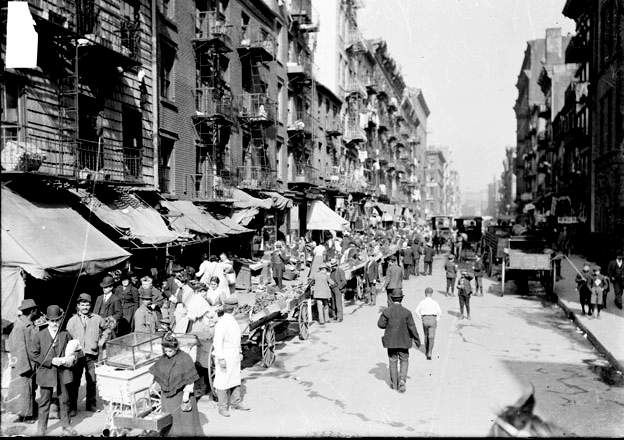
 I spent my afternoon in the Lower East Side (LES) today, something I have rarely done since high school. Thus said, it is interesting to see how much this neighborhood, my childhood home, has changed over the past few years. To me, LES is a haven for people who are seeking opportunity, something that is becoming increasingly less evident each day.
LES is one of the oldest neighborhoods in NYC and has always been the first settlement for new immigrants. The Dutch arrived during the 17th century and populated the area with farms. It eventually became a battleground with the British, creating the heart of New York. Every new wave of immigrants came to LES. In the 1800's, the Irish settled in the neighborhood's tenement homes as they fled from the potato famine. This was followed by the Italians and Germans and it was the beginning of what America should be: an ethnically diverse community. During the early 1900's, Jewish immigrants moved in, contributing delicatessens, staples to NYC. New groups moved in rapidly during the last half of the century. Blacks and Hispanics began to inhabit the area with the rise of low-income project homes in the sixties. Chinese began moving in during the seventies because of its close proximity to Chinatown. Lastly, squatters lived in vacant buildings in the eighties, which became the root of the punk rock scene.
LES has always been a rough neighborhood. Each ethnic group that lived in LES were shunned from the societal majority in some way. Thus, they have all lived in poor conditions. Every group, from the Irish and Italians to the Hispanics and Chinese have brought large families to live in the cramped conditions of tenement homes, despite inhabiting the space a century apart. Crime rates were always up no matter what decade you were in. As a child living there in the nineties, I was always told to avoid certain parts and to take precaution while playing in the parks. It was because of all this that each wave of immigrants worked hard to move out. Despite the numerous groups mentioned before, they never lived harmoniously for it became a trend for one group to move out their predecessor to move in.
Today, people are not working hard to move out but to move in. At the turn of the century, LES has become a budding hipster scene for its ghetto aesthetics. Tenement homes have been reconstructed into upscale apartments and old factory buildings have become lofts and art galleries. It is sad because you do not get as much street cred when you say you're from LES as you did twenty years ago. Yet, LES still remains to be the home for people seeking opportunity for the young people that are beginning to move in are too seeking possibilities.

